
Published on June 19, 2026
What we love
Worth knowing
Our verdict
Buy CONNEQT Pulse if you're managing hypertension, tracking cardiovascular risk, or serious about longevity and want clinical-grade arterial data at home. Skip it if a basic systolic/diastolic number is all you need—a $40 cuff will do. Best paired with a clinician who understands central pressure.
Ready to order? Visit Product →
Most home blood pressure monitors tell you what's happening at your arm. CONNEQT tells you what's happening at your heart. Built on SphygmoCor® technology—the reference standard for central aortic pressure used in cardiovascular research since the 1990s—it measures the pressure your aorta actually experiences and how stiff your arteries have become. That's the difference between a number and an explanation, and it's the gap CONNEQT was built to close.
CONNEQT didn't start as a consumer brand. It started in 1994 when Dr. Michael O'Rourke founded ATCOR Medical in Sydney, drawing on over 50 years of pioneering cardiovascular science. O'Rourke spent decades studying arterial wave reflection—the physics of how a pressure pulse travels through your arteries and bounces back toward the heart.
That research produced SphygmoCor®, a technology that became the gold standard for measuring central blood pressure in clinical and research settings. For most of its life it lived in hospitals, drug trials, and university labs.
The mission stayed consistent: improve healthspan by treating arterial health as a foundation of longevity. What changed was the ambition. The team decided the measurements that had guided pharmaceutical trials and cardiology decisions for decades shouldn't stay locked in clinics. CONNEQT is the result—the same science, repackaged for people who want to manage their own cardiovascular future at home, not just once a year at a checkup.
Here's the science that makes CONNEQT different. A standard cuff measures brachial pressure—the pressure in your upper arm. But your heart, brain, and kidneys don't experience brachial pressure. They experience central aortic pressure, which can differ meaningfully from the arm reading depending on your arterial stiffness and how pressure waves reflect back through your system.
SphygmoCor® reconstructs the central aortic pressure waveform from a peripheral measurement using a validated transfer function. From that waveform it derives metrics standard cuffs can't touch: central systolic pressure, augmentation index (how much reflected waves boost your pressure), and pulse wave velocity—the most direct measure of arterial stiffness available outside a cath lab.
Why does this matter? Two people with identical arm readings can have very different central pressures and very different cardiovascular risk. Arterial stiffness is one of the strongest predictors of future cardiac events, and it often rises before brachial pressure does.
This isn't marketing physics. SphygmoCor® has been the comparator in 11,000+ patient pharmaceutical trials and underpins more than 3,000 peer-reviewed publications. When drug companies need to prove a therapy improves arterial function, this is the tool they reach for. CONNEQT puts that same engine in a home device.
CONNEQT's lineup spans the clinical and consumer worlds, which tells you a lot about its credibility. The SphygmoCor CvMS is the lab-grade system—the one that's powered research studies for decades, running tonometry-based central pressure analysis for hospitals and clinical trial sites.
The SphygmoCor XCEL brought cuff-based central pressure measurement to busy clinical practices, removing the need for a trained operator with a tonometer. The SphygmoCor Mx serves as another professional configuration for arterial assessment in clinical settings.
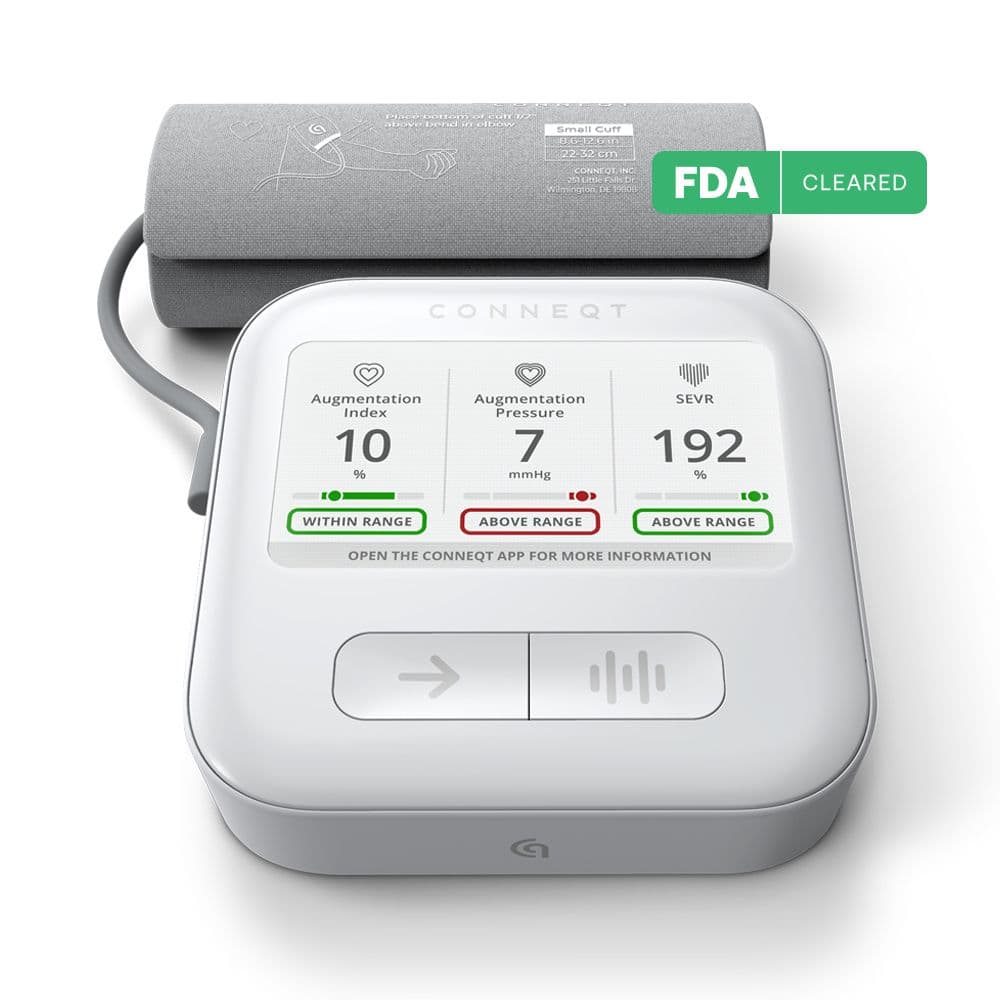
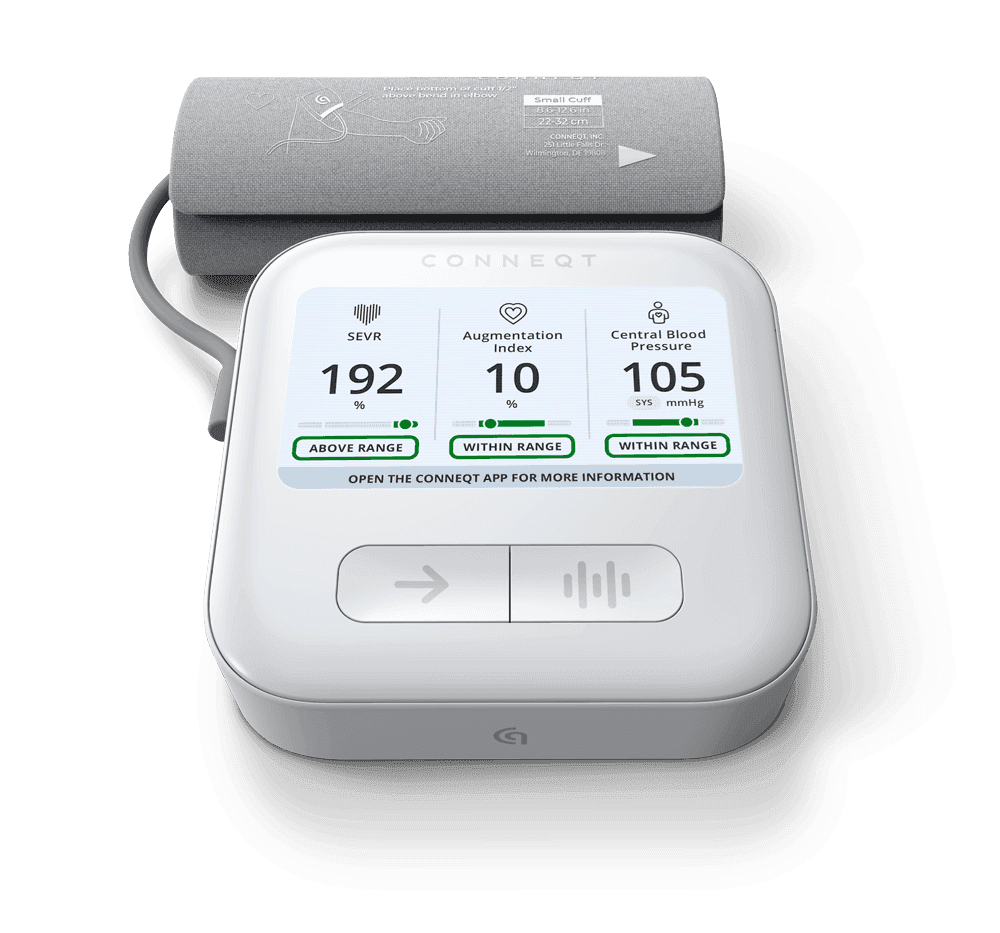
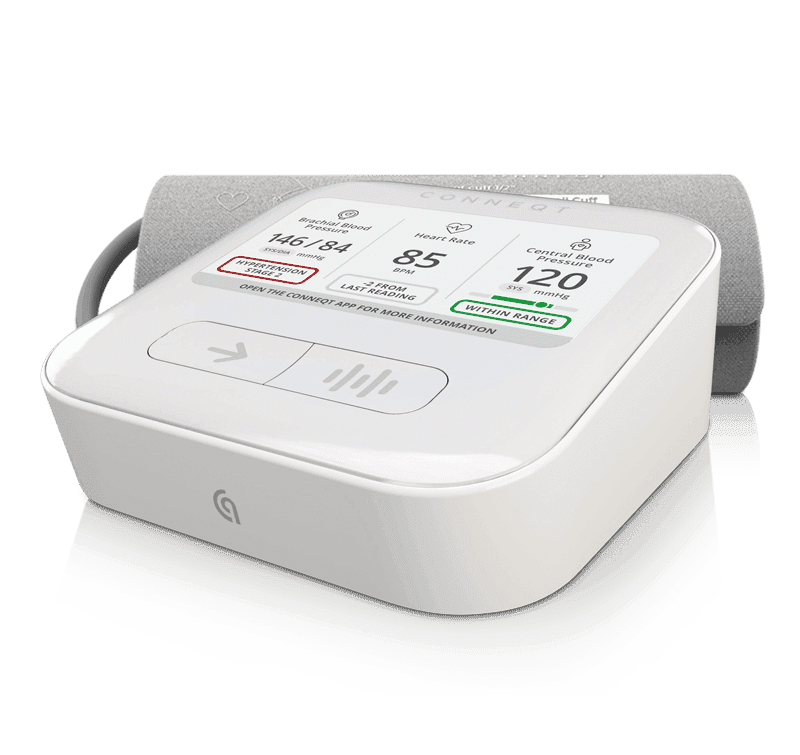
Then there's the CONNEQT Pulse—the device most readers here actually want. It's the home-and-clinic monitor that delivers central blood pressure and arterial stiffness insights from a cuff measurement you take yourself. It's the bridge product: research-grade science, consumer-grade workflow.
Across the range, the through-line is consistency. Whether a cardiologist uses the CvMS in a trial or you use the Pulse at your kitchen table, the underlying SphygmoCor® methodology is the same. That continuity is what makes home readings comparable to clinical benchmarks.
The CONNEQT Pulse is where the brand's decades of clinical work meet daily life. You strap on the cuff like any home monitor, but instead of two numbers, you get a fuller arterial picture: brachial pressure, central aortic pressure, and arterial stiffness indicators in a single session.
In practice, the value shows up over time. A one-off reading is a snapshot; CONNEQT is built for longitudinal tracking. Measuring weekly or monthly lets you watch trends—whether a new medication is actually lowering central pressure, whether a change in diet or exercise is softening arterial stiffness, whether your arterial age is moving in the right direction.
Compare that to a typical home cuff, which gives you the same systolic/diastolic readout your pharmacy's free machine does. CONNEQT answers questions those devices can't: Is my treatment working at the level that matters? Are my arteries aging faster than my calendar age suggests?
The trade-off is patience. A proper measurement takes longer than a 30-second wrist reading, and the central data deserves interpretation. This isn't a glance-and-go device—it rewards people who want to engage with the numbers and ideally share them with a clinician.
A fair question for any clinical-grade home device: can a regular person actually use this without a medical degree? Largely, yes. The cuff-based Pulse handles the technical heavy lifting automatically—you don't operate a tonometer or interpret raw waveforms.
What does take effort is understanding the output. Central systolic pressure and augmentation index aren't numbers most people grew up knowing, and the readings are most powerful when reviewed with a doctor who can put them in context. CONNEQT's clinical heritage works in your favor here: because the technology is already used by Top 20 Hospitals and 8 of the top 10 pharma companies, many cardiologists and hypertension specialists already recognize SphygmoCor® data.
Our advice: treat the first few weeks as a baseline-building period, then bring your trends to your next appointment. The device becomes far more useful as a conversation tool than as a standalone gadget.
CONNEQT is built for people who want more than a number. If you have diagnosed hypertension and want to confirm your treatment is lowering the pressure that actually reaches your organs, this is the clearest home option available. The same goes for anyone with elevated cardiovascular risk who wants early warning from arterial stiffness rather than waiting for brachial pressure to climb.
Longevity-focused users will appreciate tracking arterial age as a healthspan metric, and clinicians get a home-data stream that uses the same standard they already trust.
Who should skip it? If you simply need to confirm your blood pressure is in a healthy range and have no specific risk concerns, a $40 cuff covers you. CONNEQT's depth is wasted on casual monitoring.
CONNEQT sits firmly at the premium end of the home-health market, and that's by design. You're not paying for a cuff—you're paying for SphygmoCor® technology that took 50+ years of research to develop and earned FDA clearance across three generations (2002, 2007, 2012), CE Mark, TGA, and CFDA approvals along the way.
Against a standard $30–$60 home monitor, the gap looks steep. But the right comparison isn't a basic cuff—it's the cost and inconvenience of obtaining central pressure data through a clinic, which most people can't access on demand at all.
For someone actively managing cardiovascular risk, the value calculation is straightforward: a device that tracks the metrics most predictive of cardiac events, at home, on your schedule. For casual users, it's overkill. The price filters the audience appropriately.
CONNEQT has done something genuinely rare: taken a research-grade clinical standard and made it usable at home without diluting the science. The SphygmoCor® foundation isn't a buzzword—it's the actual technology behind thousands of studies and pharmaceutical trials, now reading your arteries in your own bathroom.
It's not for everyone. The price and the depth of data mean casual users are better served by a basic cuff. But if you're managing hypertension, watching your cardiovascular risk, or treating arterial health as central to your longevity strategy, the CONNEQT Pulse gives you insight no consumer device can match. Buy it for the trends, interpret it with your doctor, and let it show you what your arm reading never could.